Psychological Adjustment to Ageing Assessment
Measure how well you are adapting to the psychological, physical, and social changes of growing older
Take the Free Assessment →🔒 Anonymous · 22 questions · ~9 minutes · Free to start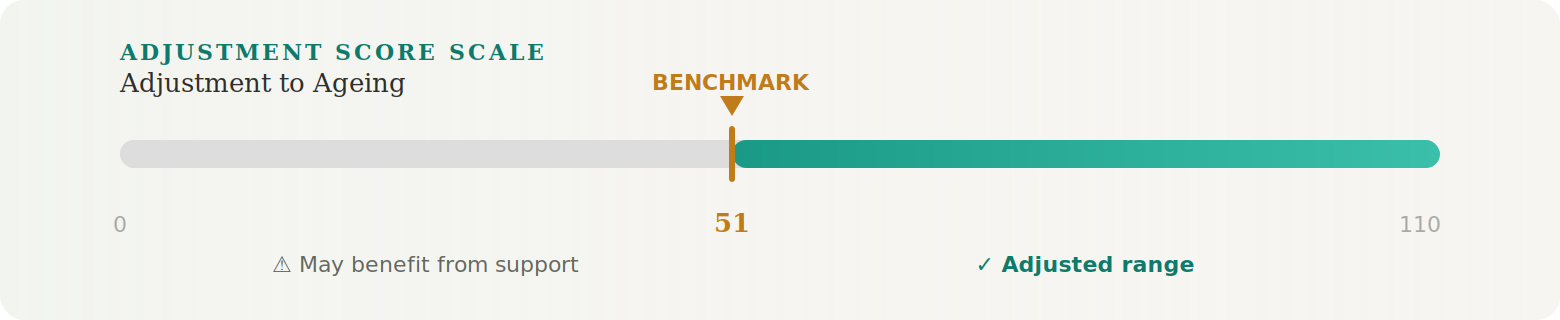
What is adjustment to ageing?
Psychological adjustment to ageing refers to the process of adapting one's internal world (values, identity, expectations, coping strategies) to the changes that accompany growing older. This includes physical changes, changes in cognitive capacity, shifts in social role and status, the loss of contemporaries, and the increasing proximity of mortality. Well-adjusted ageing does not require an absence of these changes or an unrealistic positivity about them. It requires the development of responses to them that maintain wellbeing and functioning. According to World Health Organization. Ageing and Health, the WHO identifies psychological adjustment to ageing as a core component of healthy ageing, noting that mental wellbeing in later life is shaped not only by physical health but by social connection, purpose, and adaptive capacity.
Gerontological psychology has established that adjustment to ageing is not simply a function of health or circumstance. People with significant physical limitations can be psychologically well-adjusted to ageing. People in good health can struggle badly with the psychological dimensions of growing older. What determines adjustment quality is largely the adaptive process, the degree to which a person has found ways to maintain meaning, connection, and a sense of continuity of self as the conditions of their life change.
Several psychological theories have contributed to understanding this process. Selective optimisation with compensation describes how older adults maintain wellbeing by selectively investing in fewer goals, optimising the strategies they use to pursue them, and compensating for losses with new approaches. Socio-emotional selectivity theory describes how social goals shift with age, toward depth rather than breadth of connection, toward emotional quality rather than novelty. These theoretical frameworks share a common implication: adjustment to ageing is not passive acceptance. It is an active adaptive process that some people navigate more effectively than others.
The Ageing scale of the MAB provides a validated measurement of how well that process is currently functioning for you.
What is adjustment in psychology?
Adjustment, in psychological terms, is the ongoing process by which a person adapts their internal world (thoughts, emotions, and behaviour) to the demands of their external situation. It is not about achieving a fixed state of calm or contentment. It is about the quality of the adaptive process itself. A person who is well-adjusted is not someone who faces no difficulties. They are someone who has found workable, sustainable ways of meeting the demands life places on them.
Poor adjustment does not mean weakness or failure. It means the gap between what a situation demands and what a person's current coping resources can provide has become wide enough to affect functioning. That gap can be measured, and it can be closed, usually with the right kind of support at the right time.
The Multidimensional Adjustment Battery (MAB) operationalises this definition across twenty distinct life domains, each assessed with a validated scale and compared against a published population benchmark. This makes it possible to identify exactly where a person's adjustment is strong and exactly where it is under strain, rather than relying on a single global score that averages away the detail that matters most.
Signs that your adjustment to ageing may be under strain
These signs are not evidence of weakness or failure. They are indicators that the adaptive demands of growing older have, at this point, exceeded your current coping resources:
- A persistent preoccupation with what has been lost rather than what remains. Physical capacity, roles, relationships, or opportunities that are no longer available occupy your thinking more than what continues to be possible.
- Difficulty accepting changes in how others perceive you. Being treated as less capable, less relevant, or less visible than you were at an earlier life stage produces a sustained sense of injustice or shame.
- A diminishing sense of identity continuity. The person you are now feels discontinuous from the person you were, not in a growth sense, but in a loss sense.
- Social withdrawal driven by shame or self-consciousness about ageing. Avoiding situations where your age feels visible. Physically, cognitively, or socially.
- Anxiety about health and mortality that is disproportionate and intrusive. Not the normal awareness of mortality that comes with age, but a preoccupying fear that disrupts daily functioning.
- Loss of purpose associated with changing or diminishing social roles. Retirement, children leaving home, or the loss of a primary caregiving role has removed a significant source of meaning without replacement.
- Resistance to seeking help with tasks that have become more difficult. A reluctance to acknowledge or accommodate reduced capacity, driven by shame or by a fear of what acknowledging it will mean.
Recognize some of these in yourself? See exactly where you stand, free.
Take the Free Assessment →
What the ageing assessment measures
This assessment uses the Ageing scale (MAB-12) from the Multidimensional Adjustment Battery. It consists of 22 items rated on a five-point scale, measuring your current psychological adjustment to the process of growing older.
The scale captures adjustment across several dimensions: your emotional relationship with the physical changes of ageing, your adaptation to shifting social roles and status, the continuity and quality of your social connections, your sense of personal meaning and purpose, and your psychological relationship with the prospect of increasing dependency and mortality.
The assessment captures your current adjustment state. This is important because adjustment to ageing is not fixed. It changes as circumstances change and as the specific demands of a particular stage of later life shift. A score taken during a period of good health and active social engagement may differ from a score taken after a health event or a significant bereavement.
Understanding your ageing adjustment score
The benchmark for the Ageing scale is 51 out of a maximum of 110. This is a relatively modest benchmark in proportional terms, reflecting the genuine difficulty of the adaptive demands this scale measures. A score at or above 51 indicates that your current adjustment to the demands of ageing is within a functional range.
A score below 51 indicates meaningful adjustment difficulty, a gap between the demands that growing older is placing on you and your current capacity to meet them. Given the modest threshold, a below-benchmark score reflects a more serious adaptive strain than the raw numbers might suggest.
Adjustment to ageing is an area where professional support, particularly psychological counselling with a practitioner experienced in later-life issues. Can make a significant and rapid difference. The process is not irreversible, but it benefits from being addressed rather than endured.
A score at or above 51 indicates adjustment within a functional range. Below 51 indicates that adaptive demands are exceeding current coping resources.
Who should take this assessment?
This assessment is relevant for adults of any age who are experiencing the psychological demands of growing older in ways that affect their wellbeing. While it is most directly applicable to people in their 50s, 60s, 70s, and beyond, the adjustment demands it measures (identity continuity, social role change, relationship with physical capacity) can be relevant earlier in life for people who have experienced significant health changes or early retirement.
It is also valuable for family members and carers who want to better understand the psychological experience of an ageing relative, not to complete the assessment on their behalf, but to develop a clearer understanding of what the adjustment process requires.
Frequently asked questions
Related assessments
Take the Ageing Adjustment Assessment now
Free to start. 22 questions. Anonymous. Clinically validated benchmark.
Take the Free Assessment →