Crisis & Catastrophe Adjustment Assessment
Measure how well you are recovering psychologically after a major crisis or catastrophic event
Take the Free Assessment →🔒 Anonymous · 16 questions · ~6 minutes · Free to start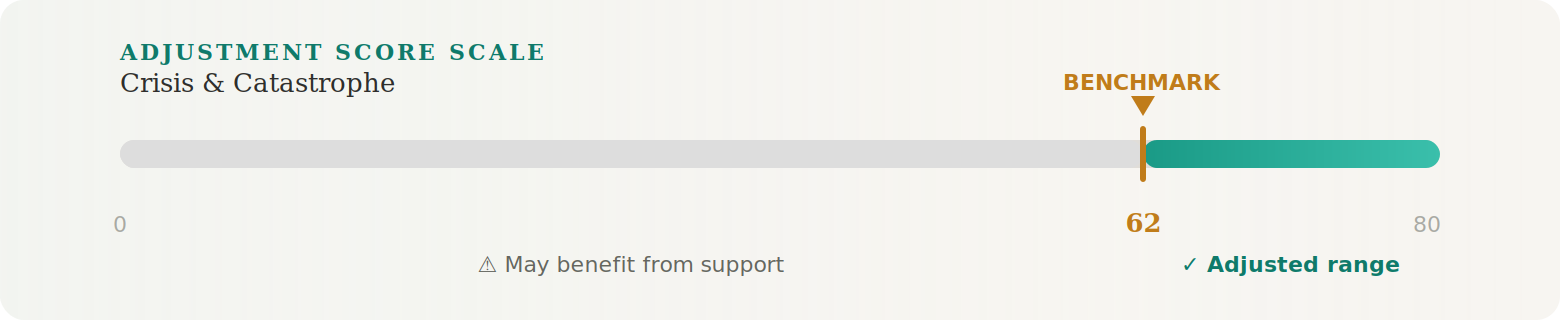
What is adjustment after crisis or catastrophe?
Adjustment following a crisis or catastrophic event refers to the psychological process of re-establishing stable functioning after a major disruption to the expected order of life. The crisis itself may be over, the flood waters may have receded, the medical emergency may have resolved, the financial crisis may have stabilised. But the psychological work of integrating what happened and rebuilding the assumptions and structures that the crisis disrupted continues long after the event itself. According to World Health Organization. Mental Health, the WHO recognises that exposure to crisis, disaster, and catastrophic events is one of the most significant risk factors for psychological adjustment difficulties, with effective measurement and early intervention shown to meaningfully improve recovery trajectories.
What makes catastrophic events particularly challenging from an adjustment perspective is the way they attack the cognitive frameworks through which people make sense of the world. Most people operate with an implicit belief in a degree of predictability, control, and fairness in life. A catastrophic event violates those assumptions, often violently, and the adjustment process involves rebuilding, not the naïve version of those beliefs, but something more realistic and more resilient.
Post-traumatic growth, the phenomenon in which some people emerge from catastrophic experiences with a deepened sense of meaning, stronger relationships, and a clearer value system. Is a real and well-documented finding in psychological research. But it is not universal, and it does not occur automatically. For many people, the aftermath of crisis produces instead post-traumatic stress, persistent anxiety, hypervigilance, avoidance, and a diminished sense of safety in the world. The clinical distinction between normal adjustment difficulty and post-traumatic stress disorder requires professional evaluation. But measurement of current adjustment quality is a useful and accessible first step.
This assessment measures that current quality of adjustment, giving you a concrete picture of where your recovery process stands.
What is adjustment in psychology?
Adjustment, in psychological terms, is the ongoing process by which a person adapts their internal world (thoughts, emotions, and behaviour) to the demands of their external situation. It is not about achieving a fixed state of calm or contentment. It is about the quality of the adaptive process itself. A person who is well-adjusted is not someone who faces no difficulties. They are someone who has found workable, sustainable ways of meeting the demands life places on them.
Poor adjustment does not mean weakness or failure. It means the gap between what a situation demands and what a person's current coping resources can provide has become wide enough to affect functioning. That gap can be measured, and it can be closed, usually with the right kind of support at the right time.
The Multidimensional Adjustment Battery (MAB) operationalises this definition across twenty distinct life domains, each assessed with a validated scale and compared against a published population benchmark. This makes it possible to identify exactly where a person's adjustment is strong and exactly where it is under strain, rather than relying on a single global score that averages away the detail that matters most.
Signs that your adjustment to crisis may be under strain
These signs can occur after any significant crisis, regardless of whether the event would conventionally be described as traumatic:
- Persistent hypervigilance or a heightened sense of threat. The world feels less safe than it did before the crisis, and that feeling has not reduced as time has passed.
- Intrusive memories, images, or thoughts about the event. Unwanted recollections of the crisis that feel involuntary and disruptive, occurring in ordinary moments without a clear trigger.
- Avoidance of people, places, or situations associated with the event. Changing your patterns of behaviour to keep away from things that remind you of what happened.
- Difficulty trusting that things are stable or safe. A persistent readiness for the next crisis, an inability to settle into ordinary life without expecting it to be disrupted.
- Emotional numbness or detachment. A flat, disconnected relationship to experiences that previously produced pleasure, warmth, or engagement.
- Sustained changes in how you think about yourself and the world. Negative beliefs about your own capacity, the safety of the world, or the reliability of others that were not present before the crisis.
- Physical symptoms with no clear medical cause. Sleep disturbance, startle responses, tension, and somatic symptoms are common features of unresolved crisis adjustment.
Recognize some of these in yourself? See exactly where you stand, free.
Take the Free Assessment →
What the crisis and catastrophe assessment measures
This assessment uses the Crisis and Catastrophe scale (MAB-16) from the Multidimensional Adjustment Battery. It consists of 16 items rated on a five-point scale, measuring your current psychological adjustment to the aftermath of a major crisis or catastrophic event.
The scale assesses adjustment across several post-crisis dimensions: the degree to which the event continues to intrude on daily functioning, your ability to re-establish a sense of safety and predictability, emotional regulation in the aftermath of the event, social functioning and the degree to which the crisis has affected relationships, and your overall sense of recovery trajectory. Whether you feel you are moving forward or remaining stuck.
The assessment does not require you to identify a specific event. It measures your current psychological state in relation to a crisis you have experienced. Whatever that crisis was. This makes it applicable to a wide range of experiences, from natural disasters to personal crises, from sudden illness to financial catastrophe.
Understanding your crisis adjustment score
The benchmark for the Crisis and Catastrophe scale is 62 out of a maximum of 80. This is a high benchmark in proportional terms (approximately 78% of the maximum) reflecting that the adjustment demands of crisis recovery are significant and that functional recovery requires an active and often effortful adaptive process.
A score at or above 62 indicates that your psychological adjustment to the aftermath of the crisis is within a functional range. A score below 62 indicates that the effects of the crisis are continuing to affect your functioning in ways that warrant professional attention. A score significantly below the benchmark (particularly if the crisis occurred more than three months ago) may warrant evaluation for post-traumatic stress disorder by a qualified mental health professional.
A score at or above 62 indicates adjustment within a functional range. Below 62 indicates that adaptive demands are exceeding current coping resources.
Who should take this assessment?
This assessment is relevant for anyone who has experienced a significant crisis or catastrophic event and is uncertain whether their recovery process is progressing normally or whether the level of difficulty they are experiencing warrants professional attention. It is applicable regardless of whether the event would conventionally be described as traumatic, the adjustment demands of financial crisis, sudden illness, and unexpected loss can be as significant as those following more overtly dramatic events.
If you are experiencing symptoms consistent with post-traumatic stress (flashbacks, severe hypervigilance, significant functional impairment) please speak with a mental health professional directly rather than relying on this assessment alone.
Frequently asked questions
Related assessments
Take the Crisis & Catastrophe Assessment now
Free to start. 16 questions. Anonymous. Clinically validated benchmark.
Take the Free Assessment →