Empty Nest Syndrome Test
Measure how well you are adjusting to life after your children leave home
Take the Free Assessment →🔒 Anonymous · 17 questions · ~7 minutes · Free to start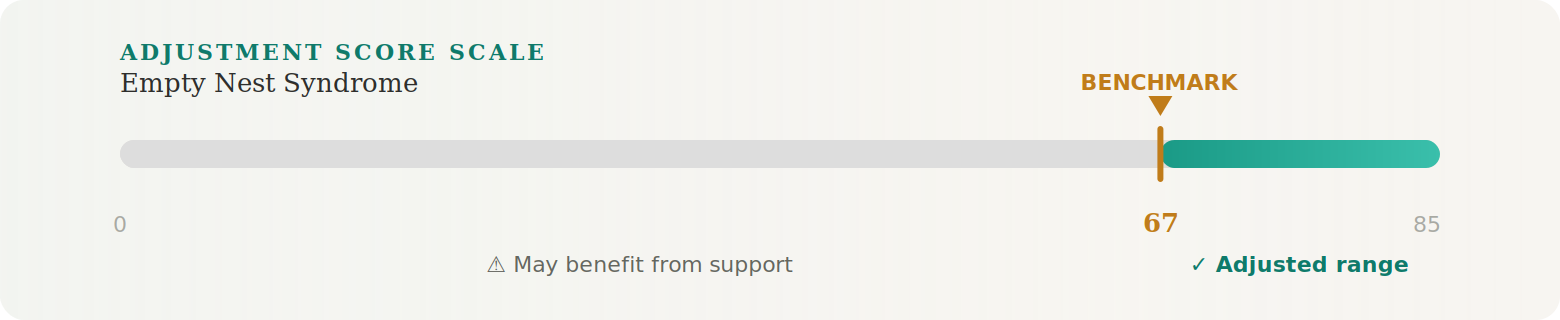
What is empty nest adjustment?
Empty nest adjustment refers to the psychological process of adapting to the transition that follows when children (typically the last or only child) leave the family home to establish their own independent lives. The term "empty nest syndrome" is informal rather than clinical, but it captures something real: a constellation of psychological responses to a significant loss of role, structure, and daily purpose that can, in some people, produce sustained adjustment difficulty. According to World Health Organization (Mental Health, the WHO recognises that significant life transitions) including changes in family structure and parenting role. Are among the most common triggers of adjustment-related mental health challenges in mid-life adults.
The transition is significant because active parenting is not merely a set of tasks. It is, for most parents, a central organising principle of adult life. Providing meaning, daily structure, social connection through school and community, a clear sense of responsibility and role, and often a substantial portion of identity. When that organising principle is removed, the adjustment demands it creates go well beyond learning to cook for fewer people.
Research on empty nest adjustment identifies several factors that influence how well the transition is managed. Parents who have maintained identities, interests, and relationships independent of their parenting role tend to adjust more easily. Parents whose primary sense of purpose and meaning was organised around active parenting, and who did not develop alternative sources of those things, tend to find the adjustment harder. The quality of the marital or partnership relationship (if one exists) also plays a significant role: some couples find the transition an opportunity to reconnect, while others discover that the children were providing structure and conversation that the relationship between adults alone cannot sustain.
The adjustment demand is real, and it is measurable. A clear picture of where your adjustment currently stands is the most useful starting point for deciding how to meet it.
What is adjustment in psychology?
Adjustment, in psychological terms, is the ongoing process by which a person adapts their internal world (thoughts, emotions, and behaviour) to the demands of their external situation. It is not about achieving a fixed state of calm or contentment. It is about the quality of the adaptive process itself. A person who is well-adjusted is not someone who faces no difficulties. They are someone who has found workable, sustainable ways of meeting the demands life places on them.
Poor adjustment does not mean weakness or failure. It means the gap between what a situation demands and what a person's current coping resources can provide has become wide enough to affect functioning. That gap can be measured, and it can be closed, usually with the right kind of support at the right time.
The Multidimensional Adjustment Battery (MAB) operationalises this definition across twenty distinct life domains, each assessed with a validated scale and compared against a published population benchmark. This makes it possible to identify exactly where a person's adjustment is strong and exactly where it is under strain, rather than relying on a single global score that averages away the detail that matters most.
Signs that your empty nest adjustment may be under strain
These signs are not evidence of problematic attachment to your children. They are indicators that the adjustment demands of this transition have exceeded your current coping resources:
- A persistent sense of purposelessness in daily life. The structure that parenting provided (the rhythm of meals, school runs, activities, homework) has gone, and nothing has filled the space in a way that feels meaningful.
- An identity that no longer feels coherent. Being a parent was so central to who you were that its change in form has left your sense of self feeling uncertain or diminished.
- Relationship difficulty with a partner or spouse. The couple relationship is under strain. Conversations feel thin, shared purpose feels absent, or the transition has surfaced tensions that parenting previously absorbed.
- Excessive focus on the adult child's life and wellbeing. Monitoring, worrying, or involving yourself in a child's daily life to a degree that reflects your own adjustment difficulty rather than their needs.
- Social withdrawal following the departure. The social world organised around parenting (other parents, school community, children's activities) has gone, and nothing has replaced it.
- A sense of grief that feels disproportionate to the circumstances. The departure of a healthy adult child should not require grief of the intensity associated with loss. When it does, that is a clinical signal.
- Difficulty finding enthusiasm for activities that do not involve parenting. Hobbies, travel, or other interests that you anticipated enjoying feel flat or unsatisfying in the absence of the primary parenting role.
Recognize some of these in yourself? See exactly where you stand, free.
Take the Free Assessment →
What the empty nest syndrome test measures
This assessment uses the Empty Nest scale (MAB-13) from the Multidimensional Adjustment Battery. It consists of 17 items rated on a five-point scale, measuring your psychological adjustment to the transition following the departure of children from the family home.
The scale captures adjustment across several dimensions: your sense of purpose and identity outside of the active parenting role, the quality of your relationship with a partner or other significant adults in the absence of the child-centred structure, your social functioning, your emotional relationship with the transition itself, and the degree to which your wellbeing has remained stable or has declined since the departure.
The assessment is relevant for parents at any point after a child's departure. Whether the last child left recently or years ago. Adjustment in this transition does not automatically improve with time; some people find that the initial period is manageable but that the difficulty deepens as the novelty of the transition passes and the permanence of the new arrangement becomes fully real.
Understanding your empty nest adjustment score
The benchmark for the Empty Nest scale is 67 out of a maximum of 85. This is a high benchmark in proportional terms (approximately 79% of the maximum score) reflecting that the adjustment demands of this transition are real and that functional adjustment requires an active adaptive response rather than a passive acceptance of the change.
A score at or above 67 indicates that your adjustment to the empty nest transition is within a functional range. A score below 67 indicates that the transition is producing adjustment difficulty that exceeds your current coping resources. Given the high threshold, even a modest shortfall below the benchmark is worth taking seriously.
Empty nest adjustment responds well to targeted therapeutic support, particularly approaches focused on identity and purpose. The transition is also one where couples therapy can be particularly valuable, as the relationship between partners often needs to be renegotiated when its organisation around parenting is removed.
A score at or above 67 indicates adjustment within a functional range. Below 67 indicates that adaptive demands are exceeding current coping resources.
Who should take this assessment?
This assessment is designed for parents whose children have left or are in the process of leaving the family home. It is most directly relevant for parents of the last or only child to depart, as the adjustment demands are typically most significant at that transition.
It is also relevant for parents who are anticipating the departure of the last child and want to understand, in advance, what adjustment demands the transition might produce and what preparation might reduce them. Taking the assessment before a child leaves can provide a useful baseline against which to compare a post-departure result.
Frequently asked questions
Related assessments
Take the Empty Nest Syndrome Test now
Free to start. 17 questions. Anonymous. Clinically validated benchmark.
Take the Free Assessment →