Graduate Unemployment Adjustment Test
Measure the psychological impact of unemployment and find out where your adjustment stands
Take the Free Assessment →🔒 Anonymous · 22 questions · ~9 minutes · Free to start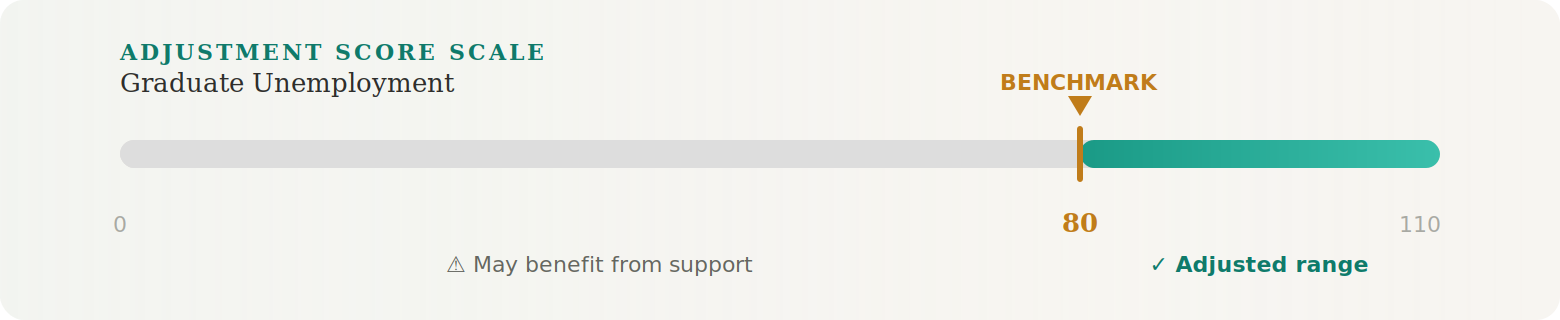
What is graduate unemployment adjustment?
Graduate unemployment adjustment refers to the psychological process of adapting to a period of unemployment following completion of higher education. It is a specific variant of unemployment adjustment because the psychological demands it creates are shaped by the particular context: the investment (of time, money, effort, and identity) that education represents, and the expectation, which most graduates hold and which most educational institutions implicitly endorse, that education leads to employment. According to World Health Organization. Mental Health, the WHO identifies unemployment as a significant social determinant of mental health, noting that the psychological impact of joblessness (on identity, purpose, and social connection) often exceeds the financial impact, particularly for graduates whose professional identity was shaped by their education.
When that expectation is not met. When graduation is followed by a period of unemployment, underemployment, or repeated rejection, the psychological adjustment demands go well beyond the practical challenge of finding work. They include demands on identity: the need to maintain a sense of competence and worth in the absence of the professional validation that employment provides. They include social demands: navigating a social world in which employment is the primary currency of adult status and identity. They include demands on purpose and structure: maintaining meaningful organisation of time when the structure that work would provide is absent.
Research on graduate unemployment consistently finds that it is the identity and meaning dimensions (more than the financial dimensions) that produce the most sustained psychological impact. This helps explain why financial support, while necessary, is not sufficient to address graduate unemployment adjustment difficulty. The identity gap that unemployment creates requires an adjustment response that is specifically psychological in character.
The MAB Graduate Unemployment scale was developed to capture the specific psychological adjustment demands of this situation, not unemployment in general, but the particular experience of a graduate whose expected transition from education to professional identity has been disrupted.
What is adjustment in psychology?
Adjustment, in psychological terms, is the ongoing process by which a person adapts their internal world (thoughts, emotions, and behaviour) to the demands of their external situation. It is not about achieving a fixed state of calm or contentment. It is about the quality of the adaptive process itself. A person who is well-adjusted is not someone who faces no difficulties. They are someone who has found workable, sustainable ways of meeting the demands life places on them.
Poor adjustment does not mean weakness or failure. It means the gap between what a situation demands and what a person's current coping resources can provide has become wide enough to affect functioning. That gap can be measured, and it can be closed, usually with the right kind of support at the right time.
The Multidimensional Adjustment Battery (MAB) operationalises this definition across twenty distinct life domains, each assessed with a validated scale and compared against a published population benchmark. This makes it possible to identify exactly where a person's adjustment is strong and exactly where it is under strain, rather than relying on a single global score that averages away the detail that matters most.
Signs that your unemployment adjustment may be under strain
These signs reflect the specific psychological demands that graduate unemployment places on wellbeing. They are not evidence of personal inadequacy. They are indicators of adjustment difficulty in response to a genuinely difficult situation:
- A growing disconnection between your self-concept and your daily reality. The person you expected to be by now (professionally, financially, socially) and the person you actually are have become increasingly difficult to reconcile.
- Social withdrawal driven by shame or comparison. Situations where employment is likely to come up (social events, family gatherings, interactions with peers) have become sources of dread or avoidance.
- Loss of daily structure that has become entrenched. The absence of the rhythm that employment would provide has settled into patterns of disorganisation or lethargy that feel difficult to change.
- Difficulty maintaining motivation for job search activity. Not the normal ebb and flow of energy in a job search, but a deepening sense of futility that makes sustained application effort feel increasingly impossible.
- A hardening belief that employment will not happen. Early optimism has given way to a settled pessimism, a sense that the situation is fixed rather than temporary.
- Relationship strain related to unemployment. Family dynamics, friendships, or a partnership under pressure from the practical or identity demands of your unemployment.
- Health behaviours declining without obvious cause. Sleep, exercise, eating, and self-care patterns deteriorating in ways not explained by financial constraints alone.
- Difficulty using free time productively or pleasurably. Unstructured time that should be available for development or enjoyment instead feels oppressive or meaningless.
Recognize some of these in yourself? See exactly where you stand, free.
Take the Free Assessment →
What the graduate unemployment test measures
This assessment uses the Graduate Unemployment scale (MAB-11) from the Multidimensional Adjustment Battery. It consists of 22 items rated on a five-point scale, measuring your current psychological adjustment to the demands of unemployment as a graduate.
The scale assesses adjustment across several dimensions: identity and self-worth in the absence of professional role, practical and temporal structure in the absence of employment, social functioning and the management of employment-related social comparison, motivation and agency in relation to the job search, and emotional regulation in the context of a prolonged or uncertain period of unemployment.
The assessment is applicable throughout a period of unemployment. From the early weeks to a period of years. Adjustment quality does not automatically improve with time; for some people, it deteriorates as the period extends and the identity and motivation challenges compound. For others, adaptation strategies improve over time. A current score reflects your actual adjustment state, not an assumption about what it should be at this stage.
Understanding your graduate unemployment adjustment score
The benchmark for the Graduate Unemployment scale is 80 out of a maximum of 110. This is a high benchmark in proportional terms (approximately 73% of the maximum) reflecting the significant and real psychological demands that this situation places on adjustment resources.
A score at or above 80 indicates that your psychological adjustment to the demands of unemployment is within a functional range. You are managing the identity, social, structural, and motivational challenges of the situation in a way that preserves your capacity to continue engaging with the process of finding employment and maintaining your wellbeing while doing so.
A score below 80 indicates that the adjustment demands are exceeding your current coping resources in ways that are likely affecting your wellbeing and, potentially, the quality and sustainability of your job search itself. This is not a comment on your capability. It is a measurement of a gap that, in most cases, responds well to targeted support.
A score at or above 80 indicates adjustment within a functional range. Below 80 indicates that adaptive demands are exceeding current coping resources.
Who should take this assessment?
This assessment is designed for graduates who are currently experiencing unemployment or who are in a period of extended underemployment following completion of higher education. It is relevant whether you graduated recently or some years ago, whether you are actively searching for work or have temporarily withdrawn from the search, and whether the period of unemployment is your first or follows a period of employment.
It is also useful for graduates who feel that they are managing the situation adequately on the surface but sense that the psychological demands are quietly accumulating in ways that are not sustainable. A clear measurement of adjustment quality is more useful than a vague sense that things should be better.
Frequently asked questions
Related assessments
Take the Graduate Unemployment Adjustment Test now
Free to start. 22 questions. Anonymous. Clinically validated benchmark.
Take the Free Assessment →