Grief & Bereavement Assessment
Understand how well you are adapting to loss, with clinical nuance, not platitudes
Take the Free Assessment →🔒 Anonymous · 19 questions · ~8 minutes · Free to start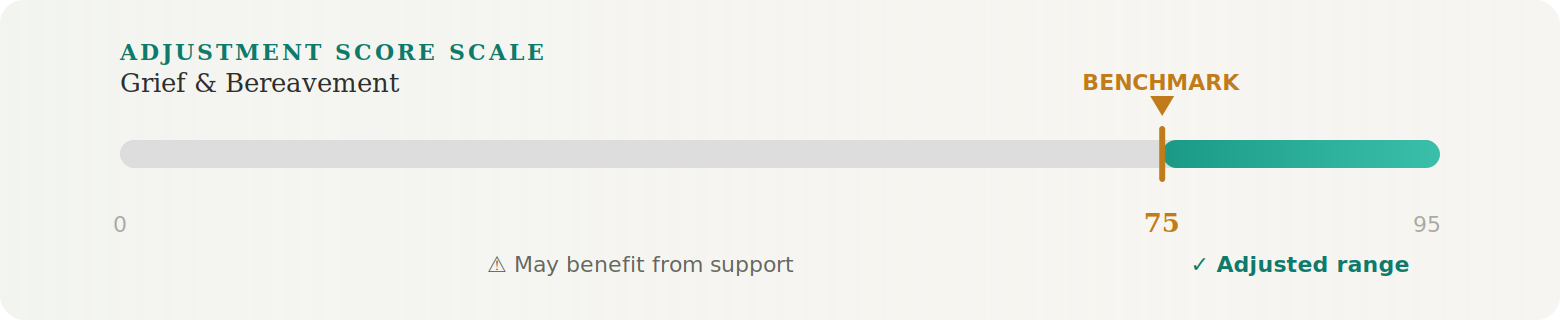
What is grief adjustment?
Grief adjustment refers to the psychological process of adapting to significant loss, typically the death of someone important, but also applicable to other forms of profound loss. It involves integrating the reality of the loss into one's sense of self and daily life in a way that allows for continued functioning, without requiring the grief to be resolved, completed, or forgotten. According to Befrienders Worldwide. International Crisis Support, Befrienders Worldwide offers a global directory of vetted crisis and bereavement support services across more than fifty countries, providing immediate access to confidential listening support for those experiencing grief and loss.
The concept of adjustment in bereavement emerged partly as a corrective to stage-based grief models, which implied a linear progression toward an endpoint. Contemporary grief research suggests a more complex picture: grief adjusts rather than ends. A well-adjusted bereaved person has not stopped grieving. They have developed a way of holding the grief alongside their ongoing life, without either suppressing it or being consumed by it.
Clinically, grief adjustment is assessed by looking at several dimensions: the degree to which grief is impairing daily functioning, the presence of continuing bonds with the deceased that are integrative rather than obstructive, the bereaved person's capacity to find meaning despite the loss, their social functioning, and the presence or absence of symptoms associated with complicated grief, a clinical condition in which adjustment has become stuck.
It is important to note that below-benchmark adjustment in bereavement is not a pathology. It is a human response to loss that has, at its current intensity or duration, crossed a threshold where additional support would likely make a meaningful difference. There is no shame in that recognition, there is only the question of whether to act on it.
What is adjustment in psychology?
Adjustment, in psychological terms, is the ongoing process by which a person adapts their internal world (thoughts, emotions, and behaviour) to the demands of their external situation. It is not about achieving a fixed state of calm or contentment. It is about the quality of the adaptive process itself. A person who is well-adjusted is not someone who faces no difficulties. They are someone who has found workable, sustainable ways of meeting the demands life places on them.
Poor adjustment does not mean weakness or failure. It means the gap between what a situation demands and what a person's current coping resources can provide has become wide enough to affect functioning. That gap can be measured, and it can be closed, usually with the right kind of support at the right time.
The Multidimensional Adjustment Battery (MAB) operationalises this definition across twenty distinct life domains, each assessed with a validated scale and compared against a published population benchmark. This makes it possible to identify exactly where a person's adjustment is strong and exactly where it is under strain, rather than relying on a single global score that averages away the detail that matters most.
Signs that your grief adjustment may be under strain
Not all of these signs indicate complicated grief. Some are normal features of bereavement. Their significance lies in their persistence, their intensity, and their effect on your ability to function:
- Grief that has not moderated in intensity over time. Loss should still hurt. But the raw, acute intensity of early grief typically moderates over months. When it does not, that is a clinical signal.
- Difficulty imagining a future. The loss has made the future feel not just uncertain but meaningless or inaccessible. As though the life you were building no longer has a coherent shape.
- Persistent avoidance of reminders of the deceased. Places, people, music, or objects associated with the person are avoided because engagement with them triggers grief that feels unmanageable.
- Feeling unable to accept that the loss has happened. A part of you continues to expect the person to return, or experiences their absence as a temporary rather than permanent state.
- Withdrawal from people who were previously important. Relationships that provided support and meaning before the loss have become sources of obligation or discomfort rather than connection.
- Loss of interest in activities that previously mattered. Hobbies, work, and social engagements that formed part of your identity before the loss now feel flat, irrelevant, or inaccessible.
- Bitterness or anger that has become chronic rather than acute. Not the normal anger of grief, but a sustained state of resentment at the loss, at the circumstances of the death, or at life itself.
Recognize some of these in yourself? See exactly where you stand, free.
Take the Free Assessment →
What the grief and bereavement assessment measures
This assessment uses the Grief and Bereavement scale (MAB-14) from the Multidimensional Adjustment Battery. It consists of 19 items rated on a five-point scale, assessing the quality of your current adjustment to bereavement.
The scale does not measure how much you loved the person you lost, how long ago the loss occurred, or whether the circumstances were traumatic. It measures your current adaptive state. How well the process of adjustment is currently functioning. This makes it applicable whether the loss was recent or years in the past, whether the death was anticipated or sudden, and whether it was the first significant loss of your life or one of many.
The assessment is sensitive to the presence of complicated grief indicators, the patterns that suggest adjustment has become stuck rather than continuing to process. Without attempting to provide a clinical diagnosis. That diagnosis, where relevant, belongs with a qualified clinician. What this assessment provides is a measurement of where you currently stand, relative to a validated benchmark.
Understanding your bereavement adjustment score
The benchmark for the Grief and Bereavement scale is 75 out of a maximum of 95. This is a relatively high benchmark in proportional terms, reflecting the fact that functional grief adjustment (the ability to carry loss while continuing to engage with life) is a genuine adaptive achievement that not everyone reaches without support.
A score at or above 75 indicates that your adjustment to bereavement is currently within a functional range. It does not mean the grief is over or that the loss no longer affects you. It means you are managing the integration of that loss in a way that preserves your capacity to function.
A score below 75 indicates that grief is currently affecting your functioning in ways that exceed your current adaptive capacity. This is not a judgment on the depth of your love or the legitimacy of your pain. It is a signal that additional support (grief counselling, therapy, or a structured bereavement support group) would likely make a meaningful difference to the trajectory of your adjustment.
A score at or above 75 indicates adjustment within a functional range. Below 75 indicates that adaptive demands are exceeding current coping resources.
Who should take this assessment?
This assessment is designed for anyone who has experienced a significant loss and wants to understand where their adjustment currently stands. "Significant" here is defined by your own experience of the loss, not by social or cultural criteria about which losses count. The death of a parent, a partner, a child, a close friend, a colleague who mattered. All of these can produce a grief process that this assessment can usefully measure.
It is also valuable for people who are not sure whether what they are experiencing is grief, depression, or something else. The assessment does not distinguish between these (that distinction requires a clinician) but a clear picture of your adjustment level can be a useful starting point for that conversation.
Frequently asked questions
Related assessments
Take the Grief & Bereavement Assessment now
Free to start. 19 questions. Anonymous. Clinically validated benchmark.
Take the Free Assessment →