Marital Adjustment Test
Find out how well you are really adapting to the demands of your relationship
Take the Free Assessment →🔒 Anonymous · 35 questions · ~14 minutes · Free to start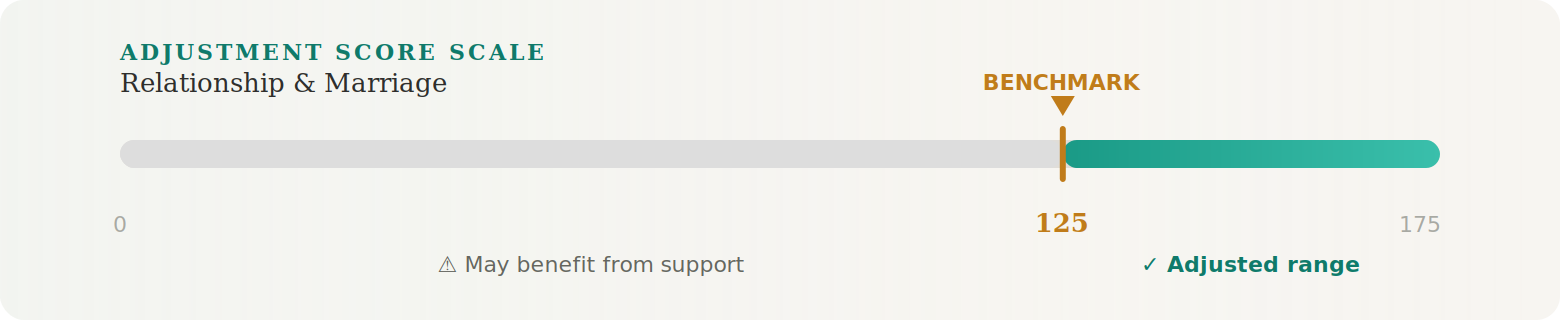
What is marital adjustment?
Marital adjustment refers to the psychological process of adapting to the ongoing demands of an intimate partnership. It is not the same as relationship satisfaction, and it is not the absence of conflict. A marriage can involve genuine tension, disagreement, and periods of emotional distance, and the partners can still be well-adjusted in the clinical sense, if they have found effective ways of working through those challenges without deteriorating. According to World Health Organization. Mental Health, the WHO notes that mental health conditions affect relationships and daily functioning globally, making accessible, validated self-assessment tools an important first step in identifying when support may be beneficial.
The distinction matters because satisfaction and adjustment measure different things. Relationship satisfaction is a feeling. It reflects how a person feels about their relationship at a given moment. Adjustment is a process. It reflects how effectively a person is meeting the adaptive demands that partnership places on them. Someone can feel quite happy in a relationship while relying on avoidant coping patterns that are slowly eroding it. Someone else can find their relationship genuinely demanding while managing those demands in ways that build rather than undermine the connection.
Clinically, marital adjustment is assessed across several dimensions: the quality of communication, the capacity for conflict resolution, the degree of emotional investment, shared decision-making, and whether both partners feel their fundamental needs are being met within the relationship. None of these dimensions require a relationship to be problem-free. They require the problems, when they arise, to be met with responses that preserve rather than compound the difficulty.
Understanding where your adjustment sits (relative to a published population benchmark) provides a far more precise starting point for change than a general sense that things could be better. It turns a vague feeling into a measurable, addressable reality.
What is adjustment in psychology?
Adjustment, in psychological terms, is the ongoing process by which a person adapts their internal world (thoughts, emotions, and behaviour) to the demands of their external situation. It is not about achieving a fixed state of calm or contentment. It is about the quality of the adaptive process itself. A person who is well-adjusted is not someone who faces no difficulties. They are someone who has found workable, sustainable ways of meeting the demands life places on them.
Poor adjustment does not mean weakness or failure. It means the gap between what a situation demands and what a person's current coping resources can provide has become wide enough to affect functioning. That gap can be measured, and it can be closed, usually with the right kind of support at the right time.
The Multidimensional Adjustment Battery (MAB) operationalises this definition across twenty distinct life domains, each assessed with a validated scale and compared against a published population benchmark. This makes it possible to identify exactly where a person's adjustment is strong and exactly where it is under strain, rather than relying on a single global score that averages away the detail that matters most.
Signs that your marital adjustment may be under strain
These patterns are not evidence of relationship failure. They are indicators that the adaptive demands of your partnership have begun to exceed your current coping resources:
- Conversations that cycle without resolution. The same disagreements resurface, each time carrying a little more weight, without reaching a workable outcome.
- Emotional withdrawal as a default response. Conflict or tension is managed by distance rather than engagement. Physically, emotionally, or both.
- A growing sense of being misunderstood. The effort of making yourself understood feels disproportionate, and the feeling of being known has dimmed.
- Intimacy that feels transactional or absent. Physical and emotional closeness has become rare, obligatory, or disconnected from genuine warmth.
- Resentment with no obvious origin. An accumulation of unaddressed grievances that has become too diffuse to name but too present to ignore.
- Difficulty making joint decisions. Shared choices (practical or significant) produce disproportionate conflict or are quietly avoided.
- One or both partners feeling consistently unappreciated. The ratio of expressed appreciation to criticism has shifted without either party quite noticing when.
- Comparing the relationship unfavourably and often. The gap between how things are and how they should be has become a persistent internal presence.
Recognize some of these in yourself? See exactly where you stand, free.
Take the Free Assessment →
What the marital adjustment test measures
The marital adjustment test on this page uses the Relationship and Marriage scale (MAB-18) from the Multidimensional Adjustment Battery. It consists of 35 statements about your experience of your relationship, scored on a five-point response scale. Some items are straightforward. They assess the presence or absence of supportive relational behaviours. Others are reverse-scored, meaning a higher response actually indicates lower adjustment, which allows the scale to detect socially desirable responding.
The scale assesses adjustment across several domains of relational functioning: communication and conflict management, emotional connection and mutual support, role clarity and shared responsibility within the partnership, and each partner's sense of personal fulfilment within the relationship. It does not assess specific relationship events or ask about relationship history. It assesses your current adaptive state.
The MAB was developed and validated by professional psychologists. The reliability coefficient (Cronbach's Alpha) for the Relationship and Marriage scale reflects the instrument's strong internal consistency. Scores are compared against a published norm derived from the instrument's development population, giving your result a genuine reference point rather than an arbitrary classification.
The assessment captures your current state. It is not a fixed verdict. Adjustment states change in response to circumstances, interventions, and time. A score taken today represents a snapshot, not a sentence.
Understanding your marital adjustment score
The benchmark for the Relationship and Marriage scale is 125 out of a maximum of 175. A score at or above 125 indicates that your adjustment to the demands of your relationship is within the range that the MAB's development population considered functional. You are managing the relational demands placed on you without significant deterioration.
A score below 125 does not mean your relationship is failing. It means the adaptive demands of your partnership are currently exceeding your available coping resources by a margin that is worth taking seriously. The further below the benchmark your score falls, the more sustained that gap is likely to be.
The full paid report gives you your exact score, your position relative to the 125 benchmark, and a plain-language interpretation of what the result means for your specific situation. It is a starting point, not a diagnosis, not a judgment, and not a prediction of what your relationship will become. It is a measurement of where things are now, so you can decide clearly what, if anything, you want to do about it.
A score at or above 125 indicates adjustment within a functional range. Below 125 indicates that adaptive demands are exceeding current coping resources.
Who should take this assessment?
This assessment is designed for anyone in a committed intimate partnership, married or not. You do not need to be experiencing serious relationship difficulties to take it. Many people take it precisely because things feel generally fine but something is quietly not right, and they want a clearer picture before that vague unease becomes a larger problem.
It is also appropriate for people who are actively working on their relationship (with a couples therapist or independently) and want a baseline measure of where their adjustment stands. Sharing your results with a therapist can provide a useful starting point for clinical work.
You do not take this assessment with your partner. It reflects your own adjustment, from your own perspective. Both partners taking it separately and comparing results is informative but not required.
Frequently asked questions
Related assessments
Take the Marital Adjustment Test now
Free to start. 35 questions. Anonymous. Your score compared against a published clinical benchmark.
Take the Free Assessment →