Occupational Stress Assessment
Find out whether your adjustment to the demands of work is within a healthy range
Take the Free Assessment →🔒 Anonymous · 32 questions · ~13 minutes · Free to start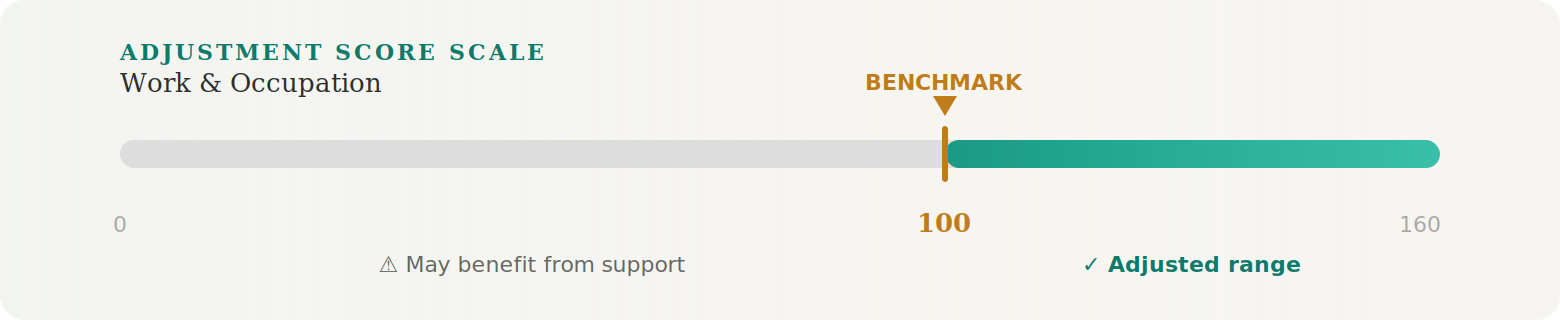
What is occupational adjustment?
Occupational adjustment refers to the psychological process of adapting effectively to the demands, conditions, and relationships of a person's working environment. It encompasses how well a person manages workload, navigates workplace relationships, maintains clarity about their role, sustains motivation, and protects their sense of professional efficacy even under pressure. According to World Health Organization. Occupational Health, the WHO recognises that the working environment is one of the most significant contributors to mental health outcomes in adults, with poor occupational conditions associated with anxiety, depression, and burnout.
The concept goes beyond occupational stress (which is the experience of pressure) to describe how a person responds to that pressure. Two people facing identical workloads can have very different adjustment profiles. One may have developed effective strategies for prioritisation, boundary-setting, and recovery that keep their adjustment well above the clinical benchmark. The other, facing the same demands without those strategies, may find their occupational adjustment declining steadily over months or years.
Occupational maladjustment is one of the most common presentations in mental health practice, yet most people experiencing it do not seek help until the deterioration has become significant. The reasons are structural: workplace culture tends to normalise high demands, and the symptoms of poor occupational adjustment (fatigue, disengagement, irritability, a loss of meaning in work) are easily attributed to temporary circumstances rather than recognised as indicators of a measurable adjustment deficit.
Measuring your occupational adjustment against a validated benchmark gives you something most people lack: a clear, objective picture of where your adjustment currently stands, before the consequences of continued strain become more difficult to reverse.
What is adjustment in psychology?
Adjustment, in psychological terms, is the ongoing process by which a person adapts their internal world (thoughts, emotions, and behaviour) to the demands of their external situation. It is not about achieving a fixed state of calm or contentment. It is about the quality of the adaptive process itself. A person who is well-adjusted is not someone who faces no difficulties. They are someone who has found workable, sustainable ways of meeting the demands life places on them.
Poor adjustment does not mean weakness or failure. It means the gap between what a situation demands and what a person's current coping resources can provide has become wide enough to affect functioning. That gap can be measured, and it can be closed, usually with the right kind of support at the right time.
The Multidimensional Adjustment Battery (MAB) operationalises this definition across twenty distinct life domains, each assessed with a validated scale and compared against a published population benchmark. This makes it possible to identify exactly where a person's adjustment is strong and exactly where it is under strain, rather than relying on a single global score that averages away the detail that matters most.
Signs that your occupational adjustment may be under strain
The following patterns are associated with below-benchmark scores on the occupational adjustment scale. They are not character flaws or signs of weakness. They are indicators that work demands have begun to outpace your adaptive resources:
- Sustained fatigue that does not resolve with rest. Recovery time between working days has shortened, and weekend or annual leave no longer fully restores your capacity.
- Disengagement from tasks that previously had meaning. Work that once felt purposeful feels mechanical, and the motivation to invest discretionary effort has diminished.
- Disproportionate emotional reactions to workplace events. Minor setbacks, criticism, or interpersonal friction produce emotional responses that feel out of scale.
- Difficulty switching off outside working hours. Work occupies your thinking during time that should function as psychological recovery. Evenings, weekends, early mornings.
- A growing sense of role ambiguity or futility. Uncertainty about what is expected, or a feeling that your efforts do not produce meaningful outcomes, has become persistent.
- Interpersonal friction with colleagues or management. Relationships that were previously functional have become sources of low-level tension or avoidance.
- Physical symptoms with no clear medical cause. Headaches, sleep disruption, gastrointestinal symptoms, and recurrent minor illness are common correlates of sustained occupational strain.
- A private calculation about exit. Thoughts about leaving (the job, the industry, or work entirely) have moved from occasional to frequent, even if action has not followed.
Recognize some of these in yourself? See exactly where you stand, free.
Take the Free Assessment →
What the occupational stress assessment measures
The occupational stress assessment on this page uses the Work and Occupation scale (MAB-8) from the Multidimensional Adjustment Battery. It consists of 32 items rated on a five-point scale, covering your experience of the psychological demands of your current working situation.
The scale assesses adjustment across several occupational domains: workload management and perceived control, role clarity and organisational fit, quality of workplace relationships and support, sense of professional efficacy and meaning, and the degree to which work demands are affecting functioning outside of working hours. Some items are reverse-scored to reduce the effect of socially desirable responding.
The assessment is not specific to any occupation, industry, or seniority level. It measures the adaptive process (how you are responding to your work demands) rather than the demands themselves. This makes it applicable whether you are a mid-career professional, a recent graduate in your first role, a senior leader managing complex responsibilities, or someone returning to work after a period of absence.
Your score is compared against a published population benchmark, giving it a concrete reference point. The full report includes your exact score, your position relative to the benchmark, and a plain-language interpretation of what the result means for your specific situation.
Understanding your occupational stress score
The benchmark for the Work and Occupation scale is 100 out of a maximum of 160. A score at or above 100 indicates that your psychological adjustment to work demands is within a functional range. You are meeting the adaptive requirements of your working environment without significant deterioration.
A score below 100 does not mean you are unable to work or that the situation is irreversible. It means the gap between what work demands of you and your current adaptive capacity has become wide enough to affect your functioning and likely your wellbeing. The size of that gap (whether you are just below the benchmark or significantly below it) influences the urgency with which it warrants attention.
Occupational adjustment responds well to targeted support. Changes in role design, professional coaching, therapeutic intervention, or sometimes simply an honest conversation with a manager can shift the trajectory considerably. But those interventions require knowing there is a gap first. This assessment provides that knowledge.
A score at or above 100 indicates adjustment within a functional range. Below 100 indicates that adaptive demands are exceeding current coping resources.
Who should take this assessment?
This assessment is appropriate for anyone in paid employment who suspects that work may be affecting their psychological wellbeing, or who wants to monitor their occupational adjustment as a preventative measure. It is particularly useful for people who feel that they are managing (just about) but sense that the margin has narrowed and is not recovering between periods of high demand.
It is also well-suited to people who are considering a significant workplace change (a new role, a different organisation, or a move out of the workforce) and want to understand clearly whether that change is driven by genuine maladjustment or by factors that a different kind of support might address more effectively.
Frequently asked questions
Related assessments
Take the Occupational Stress Assessment now
Free to start. 32 questions. Anonymous. Clinically validated benchmark.
Take the Free Assessment →