Retirement Adjustment Test
Measure how well you are adjusting to life after paid work
Take the Free Assessment →🔒 Anonymous · 18 questions · ~7 minutes · Free to start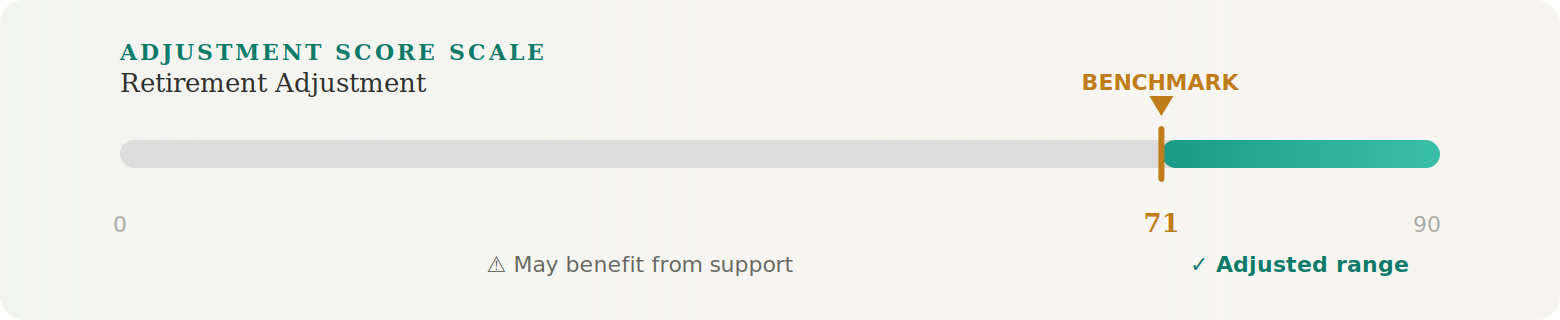
What is retirement adjustment?
Retirement adjustment refers to the psychological process of adapting to the transition from structured paid employment to a different form of daily life. It is not simply a matter of managing time differently. It involves renegotiating identity (who you are when your professional role no longer defines you) restructuring social life, which for many people was substantially organised around work, and finding new sources of purpose that can replace the ones that work provided.
Research on retirement adjustment consistently identifies several factors that distinguish people who adjust well from those who struggle. Those who adjust well typically have a portfolio of activities and relationships that existed independently of work before retirement, tend to approach the transition as an active project rather than a passive default, and maintain a sense of agency and meaning in how they structure their days. Those who struggle often find that their identity was more thoroughly organised around work than they realised, or that the relationships and interests they planned to develop in retirement require more active cultivation than they anticipated.
Crucially, retirement adjustment difficulty is not correlated with financial security. People with comfortable material circumstances can find the psychological transition very difficult, while people with more constrained resources can adjust well. This underscores that what is at stake is psychological (the rebuilding of meaning, structure, identity, and connection) rather than primarily financial.
The adjustment demands of retirement do not resolve automatically with the passage of time. Without active engagement with what the transition requires, adjustment can remain poor for years. Measurement is the first step in making those requirements visible.
What is adjustment in psychology?
Adjustment, in psychological terms, is the ongoing process by which a person adapts their internal world (thoughts, emotions, and behaviour) to the demands of their external situation. It is not about achieving a fixed state of calm or contentment. It is about the quality of the adaptive process itself. A person who is well-adjusted is not someone who faces no difficulties. They are someone who has found workable, sustainable ways of meeting the demands life places on them.
Poor adjustment does not mean weakness or failure. It means the gap between what a situation demands and what a person's current coping resources can provide has become wide enough to affect functioning. That gap can be measured, and it can be closed, usually with the right kind of support at the right time.
The Multidimensional Adjustment Battery (MAB) operationalises this definition across twenty distinct life domains, each assessed with a validated scale and compared against a published population benchmark. This makes it possible to identify exactly where a person's adjustment is strong and exactly where it is under strain, rather than relying on a single global score that averages away the detail that matters most.
Signs that your retirement adjustment may be under strain
These signs do not indicate that retirement was the wrong choice. They indicate that the adjustment demands of the transition are currently exceeding your adaptive resources:
- A persistent sense of purposelessness. Days feel unstructured in a way that has shifted from freedom to emptiness, the absence of demands has become its own kind of burden.
- Loss of professional identity without a replacement. When someone asks what you do, the honest answer no longer feels like an identity rather than just a description of how you spend your time.
- Significant reduction in meaningful social contact. The realisation that work was providing the majority of your adult social connection, and that without it the social world has contracted sharply.
- A growing restlessness or boredom that does not respond to activity. Filling time with activity helps temporarily but does not address the underlying sense that something important is absent.
- Your partner or family absorbing the social and structural needs work previously met. The relationships closest to you are now under pressure from needs they were not designed to bear alone.
- Difficulty enjoying leisure that was previously anticipated with pleasure. Activities you looked forward to during your working life (travel, hobbies, unstructured time) are less satisfying than you expected.
- Reluctance to look too far ahead. The future feels less structured and therefore less real. Planning beyond the near term produces anxiety rather than anticipation.
Recognize some of these in yourself? See exactly where you stand, free.
Take the Free Assessment →
What the retirement adjustment test measures
This assessment uses the Retirement scale (MAB-15) from the Multidimensional Adjustment Battery. It consists of 18 items rated on a five-point scale, measuring your current psychological adjustment to retirement as a life transition.
The scale captures several dimensions of retirement adjustment: your sense of purpose and daily structure, the quality of your social connection outside of former professional relationships, your sense of identity in the absence of professional role, your engagement with activities that provide meaning, and your emotional relationship with the transition itself. Whether you experience retirement primarily as gain, primarily as loss, or as the complex mixture it typically is.
The assessment is applicable whether you are recently retired or have been retired for several years. Adjustment in retirement is not a one-time event. It is an ongoing process that can shift significantly in response to changing circumstances, health, relationships, or the depth of engagement with activities that provide meaning.
Understanding your retirement adjustment score
The benchmark for the Retirement scale is 71 out of a maximum of 90. A score at or above 71 indicates that your psychological adjustment to retirement is within a functional range. You have found, or are finding, ways to meet the identity, purpose, social, and structural demands that the transition has placed on you.
A score below 71 indicates that one or more of these demands is currently unmet in ways that are affecting your wellbeing. Given the high benchmark-to-maximum ratio of this scale, a below-threshold score reflects meaningful difficulty rather than minor adjustment challenges.
Retirement adjustment difficulty is highly responsive to intervention. Structured programmes (particularly those focused on purpose, social reconnection, and identity) have a strong evidence base. A clear picture of where your adjustment currently stands is the starting point for choosing what kind of support to seek.
A score at or above 71 indicates adjustment within a functional range. Below 71 indicates that adaptive demands are exceeding current coping resources.
Who should take this assessment?
This assessment is appropriate for anyone who has retired from paid employment, regardless of how long ago the transition occurred. It is particularly useful for people who are approaching or within the first two years of retirement (a period during which adjustment demands are typically most intense) and for people who retired several years ago and find that the adjustment they expected has not materialised in the way they hoped.
It is also relevant for people who are contemplating retirement and want to understand, in advance, what psychological preparation the transition might require.
Frequently asked questions
Related assessments
Take the Retirement Adjustment Test now
Free to start. 18 questions. Anonymous. Clinically validated benchmark.
Take the Free Assessment →