Widowhood Adjustment Test
Measure how well you are adjusting to life after the loss of your partner
Take the Free Assessment →🔒 Anonymous · 22 questions · ~9 minutes · Free to start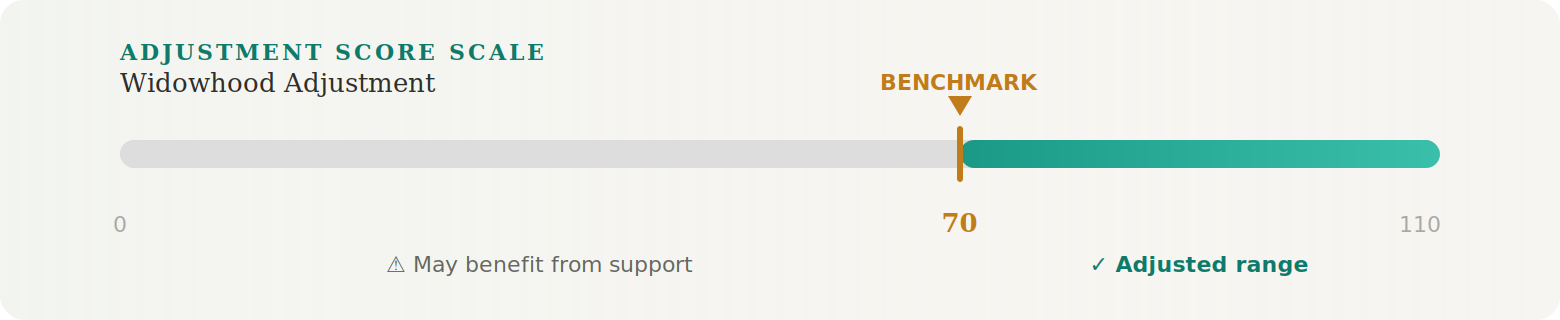
What is widowhood adjustment?
Widowhood adjustment refers to the psychological process of adapting to the profound and multi-dimensional change that follows the death of a partner or spouse. It is distinct from, though deeply intertwined with, the grief process. Grief describes the emotional experience of loss. Adjustment describes the broader adaptive process. How effectively a person is rebuilding the practical, social, identity, and emotional structures of their life in the aftermath of that loss. According to Befrienders Worldwide. International Crisis Support, Befrienders Worldwide maintains a global network of vetted bereavement and crisis support services, offering confidential support to people navigating the profound adjustment demands of loss and widowhood.
The adjustment demands of widowhood are extensive and often unexpected. They include practical demands, such as financial management, domestic tasks, and legal and administrative matters that may have been shared or delegated, alongside social demands, as the social world organised around a couple is fundamentally different from the social world navigated as a single person. They include identity demands, as the loss of a long-term partner typically requires significant reconstruction of the sense of self. And they include the ongoing demands of grief itself, which does not proceed on a timetable.
Research on widowhood adjustment consistently finds that it is not determined primarily by the intensity of grief. Some people who grieve very intensely still maintain good adjustment. They have support structures, coping resources, and adaptive strategies that allow them to hold the grief while continuing to function. Others who grieve less visibly find the adjustment demands overwhelming, particularly in the practical and social dimensions. Adjustment is the quality of the adaptive process, not the absence of pain.
One of the most important findings in widowhood research is that adjustment trajectories vary enormously, and that people who adjust poorly are not necessarily adjusting to the grief per se. They are often adjusting poorly to the specific practical, social, or identity demands that the loss has created. Understanding which domains are most affected is the starting point for effective support.
What is adjustment in psychology?
Adjustment, in psychological terms, is the ongoing process by which a person adapts their internal world (thoughts, emotions, and behaviour) to the demands of their external situation. It is not about achieving a fixed state of calm or contentment. It is about the quality of the adaptive process itself. A person who is well-adjusted is not someone who faces no difficulties. They are someone who has found workable, sustainable ways of meeting the demands life places on them.
Poor adjustment does not mean weakness or failure. It means the gap between what a situation demands and what a person's current coping resources can provide has become wide enough to affect functioning. That gap can be measured, and it can be closed, usually with the right kind of support at the right time.
The Multidimensional Adjustment Battery (MAB) operationalises this definition across twenty distinct life domains, each assessed with a validated scale and compared against a published population benchmark. This makes it possible to identify exactly where a person's adjustment is strong and exactly where it is under strain, rather than relying on a single global score that averages away the detail that matters most.
Signs that your widowhood adjustment may be under strain
These signs reflect the multi-dimensional nature of widowhood adjustment difficulty. They do not indicate failure to grieve appropriately. They indicate specific adaptive demands that currently exceed your available resources:
- Practical overwhelm that has not reduced over time. The domestic, financial, and administrative demands that your partner previously shared or managed remain unmanageably difficult.
- A collapse of the social world that existed as a couple. Friends, activities, and social structures that were organised around your life together have not been maintained or rebuilt.
- Loss of identity that extends beyond grief. Not only missing your partner, but having lost a clear sense of who you are and what your life is for in their absence.
- Difficulty making decisions independently. The habit of shared decision-making has left you without confidence in your own judgement, even for small or everyday choices.
- Physical neglect driven by loss of motivation or structure. Eating, sleeping, and self-care have declined not only in the acute phase of grief but persistently.
- A sense that the future is an empty space. Plans and expectations for later life were built around the partnership. Without it, the future feels formless or irrelevant.
- Isolation that has deepened rather than eased. Social contact has reduced further rather than stabilising or rebuilding as time passes.
- Significant difficulty with anniversaries, holidays, and milestones. Not normal difficulty, but a disproportionate, annual intensification of distress that does not reduce year on year.
Recognize some of these in yourself? See exactly where you stand, free.
Take the Free Assessment →
What the widowhood adjustment test measures
This assessment uses the Widowhood scale (MAB-17) from the Multidimensional Adjustment Battery. It consists of 22 items rated on a five-point scale, measuring your current psychological adjustment to the demands of widowhood.
The scale captures adjustment across several dimensions: emotional adjustment to the loss, practical functioning in the absence of a shared domestic and financial structure, social adjustment to life as a single person in a socially couple-oriented world, identity adjustment (who you are without the person who shared your life) and the degree to which you have maintained or rebuilt a sense of purpose and future orientation.
The assessment is applicable at any point after bereavement. Whether the loss occurred recently or years ago. Widowhood adjustment does not resolve automatically with time. Some people find that the initial years are managed through the momentum of grief's intensity, and that the deeper adjustment demands emerge only when that intensity modulates and they are left to build their new life consciously.
Understanding your widowhood adjustment score
The benchmark for the Widowhood scale is 70 out of a maximum of 110. A score at or above 70 indicates that your psychological adjustment to widowhood is within a functional range. You are meeting the adaptive demands of this transition in a way that preserves your capacity to function, even if the grief remains present and real.
A score below 70 indicates that one or more dimensions of widowhood adjustment are currently producing difficulty that exceeds your adaptive resources. The full report will give you your exact score and a detailed plain-language interpretation of what that result means in the context of the widowhood transition specifically.
Widowhood adjustment is an area with a strong evidence base for intervention. Bereavement counselling, widowhood support groups, practical support services, and individual therapy have all demonstrated meaningful impact on adjustment trajectories. The first step is a clear understanding of where adjustment currently stands.
A score at or above 70 indicates adjustment within a functional range. Below 70 indicates that adaptive demands are exceeding current coping resources.
Who should take this assessment?
This assessment is designed for anyone who has lost a partner or spouse. Whether through death in recent months or years in the past. It is relevant regardless of the age at which the loss occurred, the length of the partnership, or the circumstances of the death. Adjustment demands are present across all of these variations, though their specific character may differ.
It is also relevant for family members, friends, or carers who are supporting a bereaved person and want to understand, from a clinical perspective, what the adjustment process involves and what signs of difficulty might warrant professional attention, not to complete the assessment on behalf of the bereaved person, but to inform their own understanding.
Frequently asked questions
Related assessments
Take the Widowhood Adjustment Test now
Free to start. 22 questions. Anonymous. Clinically validated benchmark.
Take the Free Assessment →