Work–Family Balance Assessment
Measure how well you are adjusting to the competing demands of professional and family life
Take the Free Assessment →🔒 Anonymous · 22 questions · ~9 minutes · Free to start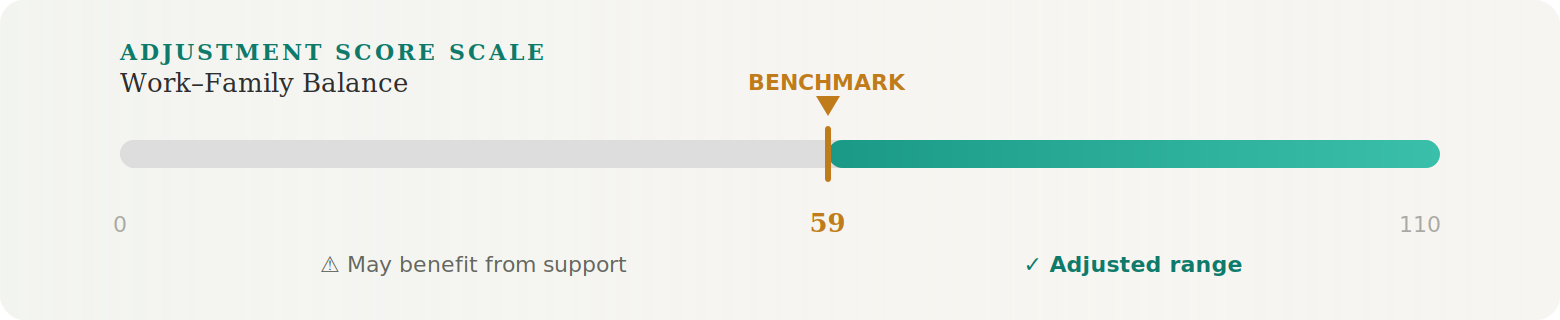
What is work-family adjustment?
Work-family adjustment describes the psychological process of managing the demands that arise when professional responsibilities and family obligations compete for the same finite resources. Time, attention, energy, and emotional availability. The challenge is not simply that both domains are demanding. It is that the demands of each often conflict in ways that make fully meeting either feel impossible, and that the resulting sense of perpetual inadequacy carries its own psychological cost. According to World Health Organization. Occupational Health, the WHO identifies work-family conflict as a significant driver of occupational health deterioration, particularly as the boundary between professional and personal life has blurred in modern working environments.
Researchers distinguish between two directions of this conflict. Work-to-family conflict occurs when work demands (long hours, unpredictable schedules, work preoccupying evening and weekend time) impair a person's functioning as a partner, parent, or family member. Family-to-work conflict occurs when family demands, such as a sick child, a difficult family event, or the cognitive load of domestic management, impair a person's concentration and performance at work. Both forms are common; both are captured in this assessment.
Adjustment, in this context, does not mean the absence of conflict. It means the presence of workable strategies (practical, cognitive, and emotional) for managing it without sustained deterioration in either domain. A person who is well-adjusted to work-family demands may be busy, stretched, and sometimes genuinely tired. What distinguishes them from someone who is poorly adjusted is not the absence of pressure but the presence of patterns that keep the pressure from compounding into chronic strain.
The benchmark norm for this scale (59 out of 110) reflects the adaptive level of the instrument's development population. It is a modest benchmark in absolute terms, reflecting how genuinely difficult this balance is for most people.
What is adjustment in psychology?
Adjustment, in psychological terms, is the ongoing process by which a person adapts their internal world (thoughts, emotions, and behaviour) to the demands of their external situation. It is not about achieving a fixed state of calm or contentment. It is about the quality of the adaptive process itself. A person who is well-adjusted is not someone who faces no difficulties. They are someone who has found workable, sustainable ways of meeting the demands life places on them.
Poor adjustment does not mean weakness or failure. It means the gap between what a situation demands and what a person's current coping resources can provide has become wide enough to affect functioning. That gap can be measured, and it can be closed, usually with the right kind of support at the right time.
The Multidimensional Adjustment Battery (MAB) operationalises this definition across twenty distinct life domains, each assessed with a validated scale and compared against a published population benchmark. This makes it possible to identify exactly where a person's adjustment is strong and exactly where it is under strain, rather than relying on a single global score that averages away the detail that matters most.
Signs that your work-family adjustment may be under strain
The following patterns are commonly associated with below-benchmark work-family adjustment scores:
- Being physically present in one place but mentally in the other. You are at work but preoccupied with family, or at home but unable to stop thinking about work, and this is the default, not the exception.
- Guilt as a persistent background state. Not acute guilt about specific failures, but a chronic low-level guilt that has become normalised, an ambient sense that you are always letting one domain down.
- A diminishing sense of competence in both roles. The feeling that you are not doing either job well enough, and that the quality of your performance in each is declining.
- Relationships at home that bear the weight of work frustration. Irritability, emotional unavailability, or low patience with family members, particularly in the evenings or at transitions between roles.
- Work performance affected by family cognitive load. Difficulty concentrating, missed deadlines, or reduced quality of work output that you attribute to mental bandwidth being consumed by family concerns.
- Weekends or family time that do not restore you. Time that should provide recovery from work demands instead produces its own set of demands that leave you no less depleted.
- Resentment directed at either domain for the existence of the other. A quiet anger at work for the time it takes from family, or at family demands for their intrusion into work.
Recognize some of these in yourself? See exactly where you stand, free.
Take the Free Assessment →
What the work-family balance assessment measures
This assessment uses the Work and Family Balance scale (MAB-10) from the Multidimensional Adjustment Battery. It consists of 22 items rated on a five-point scale, measuring the quality of your adjustment to the competing demands of your professional and family roles.
The scale captures adjustment across several dimensions: the degree to which work demands are encroaching on family functioning, the degree to which family demands are encroaching on work functioning, your sense of control over the boundary between these domains, your ability to be psychologically present in each domain when you are there, and the broader impact of this dual-role strain on your wellbeing.
The assessment is relevant for parents and non-parents alike. Family, in the context of this scale, refers to the primary domestic and relational obligations of your life outside of work. This includes partnerships, elder care, and other family roles regardless of whether children are present.
Your score reflects your current adjustment state. Like all MAB scales, it measures a process rather than a trait. It can change as circumstances change, and it can improve with targeted support or structural changes to how the two domains are managed.
Understanding your work-family balance score
The benchmark for the Work and Family Balance scale is 59 out of a maximum of 110. A score at or above 59 indicates that your adjustment to the competing demands of work and family is within a functional range. It does not indicate that the balance is easy, the benchmark itself reflects a population in which this tension is commonplace.
A score below 59 indicates that the adjustment demands of this dual-role situation are currently exceeding your available coping resources. Given the modest benchmark, a below-threshold score reflects genuine and sustained strain rather than a temporary period of higher-than-usual demand.
The interpretation matters here: this is one of the few MAB scales where a score close to the benchmark (just above it) may still warrant reflection. The question is not only whether you meet the threshold but how much margin you have above it, and whether that margin is stable or eroding.
A score at or above 59 indicates adjustment within a functional range. Below 59 indicates that adaptive demands are exceeding current coping resources.
Who should take this assessment?
This assessment is relevant for anyone who holds both professional responsibilities and meaningful family obligations simultaneously, which describes most working adults at some point in their lives. It is particularly valuable for people who are navigating a new intersection of demands: a recent promotion, a new child, a change in a partner's work status, the addition of elder care responsibilities, or a return to work after parental leave.
It is also useful as a periodic check-in for people who feel that the balance they had previously achieved has recently shifted. Sometimes the shift is gradual and almost invisible until a measurement makes it concrete.
Frequently asked questions
Related assessments
Take the Work–Family Balance Assessment now
Free to start. 22 questions. Anonymous. Clinically validated benchmark.
Take the Free Assessment →