Psychological Adjustment Test
Find out how grounded, stable, and in control your mental state really is right now
Take the Free Assessment →🔒 Anonymous · 30 questions · ~11 minutes · Free to start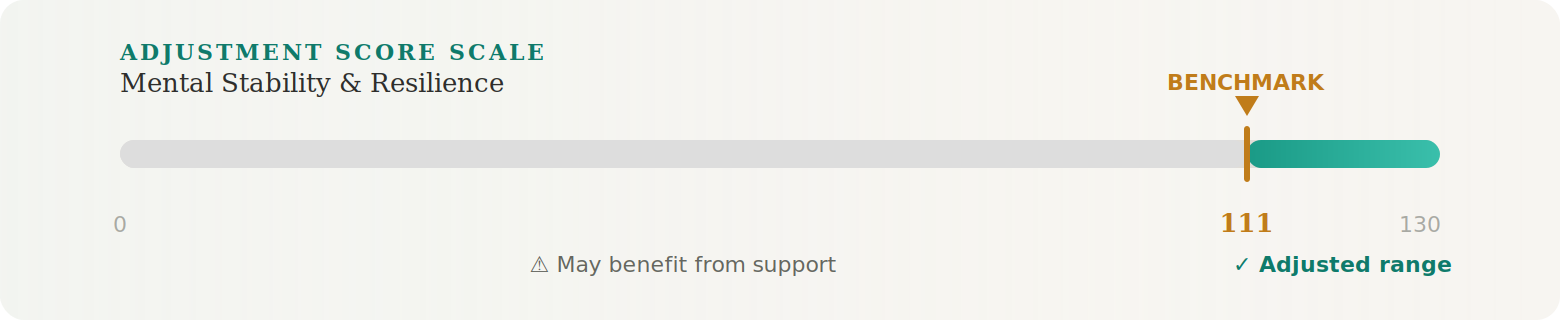
What is psychological adjustment?
Psychological adjustment refers to a person's overall mental groundedness: how stable their thinking feels, how well they can regulate their reactions under pressure, and how intact their basic sense of safety and trust in the world remains. It sits at a more foundational level than any single domain like mood or anxiety. It is closer to the underlying operating system that those other domains run on.
This scale covers a wide span deliberately, because psychological groundedness shows up in many different ways: clarity versus confusion under stress, a stable self-concept versus one that feels deflated or hostile toward itself, emotional control versus frequent flare-ups, and, at the more significant end, experiences like intrusive fear, a sense of being pursued or threatened, or perceptual disturbances that warrant direct attention rather than being brushed aside.
Because it spans such a wide range, from everyday stress tolerance to more serious warning signs, this is one of the most clinically significant assessments in the battery. A lower score here is not something to interpret casually, and the full report is written to reflect that.
What is adjustment in psychology?
Adjustment, in psychological terms, is the ongoing process by which a person adapts their internal world (thoughts, emotions, and behaviour) to the demands of their external situation. It is not about achieving a fixed state of calm or contentment. It is about the quality of the adaptive process itself. A person who is well-adjusted is not someone who faces no difficulties. They are someone who has found workable, sustainable ways of meeting the demands life places on them.
Poor adjustment does not mean weakness or failure. It means the gap between what a situation demands and what a person's current coping resources can provide has become wide enough to affect functioning. That gap can be measured, and it can be closed, usually with the right kind of support at the right time.
The Multidimensional Adjustment Battery (MAB) operationalises this definition across twenty distinct life domains, each assessed with a validated scale and compared against a published population benchmark. This makes it possible to identify exactly where a person's adjustment is strong and exactly where it is under strain, rather than relying on a single global score that averages away the detail that matters most.
Signs that your psychological adjustment may be under strain
These patterns span a wide range of severity. Some are common and manageable; others are signals that deserve prompt attention from a mental health professional. The list below moves roughly from everyday strain toward more significant concerns:
- A mind that feels scattered or hard to settle. Difficulty holding a clear train of thought, especially under any kind of pressure.
- A sense of emptiness or that life has become meaningless. A flatness that goes beyond ordinary low mood, touching your sense of purpose itself.
- Frequent anger, argument, or conflict that feels hard to control. Reactions to frustration that escalate faster or further than you intend.
- Persistent fear without a clear or proportionate cause. Feeling frightened, threatened, or on edge in situations that don't obviously warrant it.
- A pervasive sense of distrust or being targeted. A recurring feeling that people around you, or the world in general, are working against you.
- Perceptual experiences that concern you, such as hearing things others don't. This is a significant symptom category, not a minor item. If this reflects your current experience, please treat it as a priority to discuss with a doctor or mental health professional.
Recognize some of these in yourself? See exactly where you stand, free.
Take the Free Assessment →
What the psychological adjustment test measures
The psychological adjustment test on this page uses the Psychological Adjustment scale (MAB-4) from the Multidimensional Adjustment Battery. It consists of 30 statements about your overall mental state, scored on a five-point response scale. Twenty-three of the items are reverse-scored, since the large majority of this scale's items describe strain directly.
The scale spans several dimensions of psychological functioning: cognitive clarity versus confusion, emotional stability and self-regard, stress tolerance, interpersonal trust, and a set of more clinically significant items covering intrusive fear, a sense of persecution, and perceptual disturbance. It is one of the broadest-reaching scales in the MAB precisely because psychological groundedness underlies so much of how the other, more specific domains function.
The MAB was developed and validated by professional psychologists, and the Psychological Adjustment scale carries a Cronbach's Alpha of 0.889, indicating strong internal consistency. Your score is compared against a published norm from the instrument's development population.
Understanding your psychological adjustment score
The benchmark for the Psychological Adjustment scale is 111 out of a maximum of 130. A score at or above 111 indicates that your overall mental groundedness, across thinking clarity, emotional control, trust, and basic stability, is currently within a functional range.
A score below 111 means this scale has picked up on meaningful strain somewhere in that broad span. Because the scale includes items on intrusive fear, perceptual disturbance, and suicidal ideation, a below-benchmark result here deserves to be taken seriously and discussed with a doctor or mental health professional, rather than treated as something to simply monitor. If any individual item touching on suicidal thoughts, hearing things others don't, or a persistent sense of being pursued reflects your current experience, please see the crisis resources shown alongside your result and consider reaching out for support now, regardless of your overall score.
The full paid report gives you your exact score, your position relative to the 111 benchmark, and a plain-language interpretation, with the more clinically significant content flagged clearly rather than folded anonymously into a single number.
A score at or above 111 indicates that your psychological adjustment is within the range the MAB's development population considered functional. A score below 111 suggests meaningful strain in your overall mental groundedness, and given the range of content this scale covers, is worth discussing with a mental health professional rather than managing alone.
Who should take this assessment?
This assessment is suited to anyone who wants a broad, structured read on their overall psychological stability, whether prompted by a specific concern, a general sense of being less grounded than usual, or simply wanting a periodic check-in.
Because this scale's content ranges from everyday stress tolerance to more clinically significant symptoms, it is also a reasonable starting point for anyone unsure whether what they're experiencing is worth raising with a doctor. A below-benchmark result is a concrete, specific reason to have that conversation.
Frequently asked questions
Related assessments
Take the Psychological Adjustment Test now
Free to start. 30 questions. Anonymous. Your score compared against a published clinical benchmark.
Take the Free Assessment →